The Smarter Project






Smarter is used as an instructional tool at University of British Columbia for teaching AI.
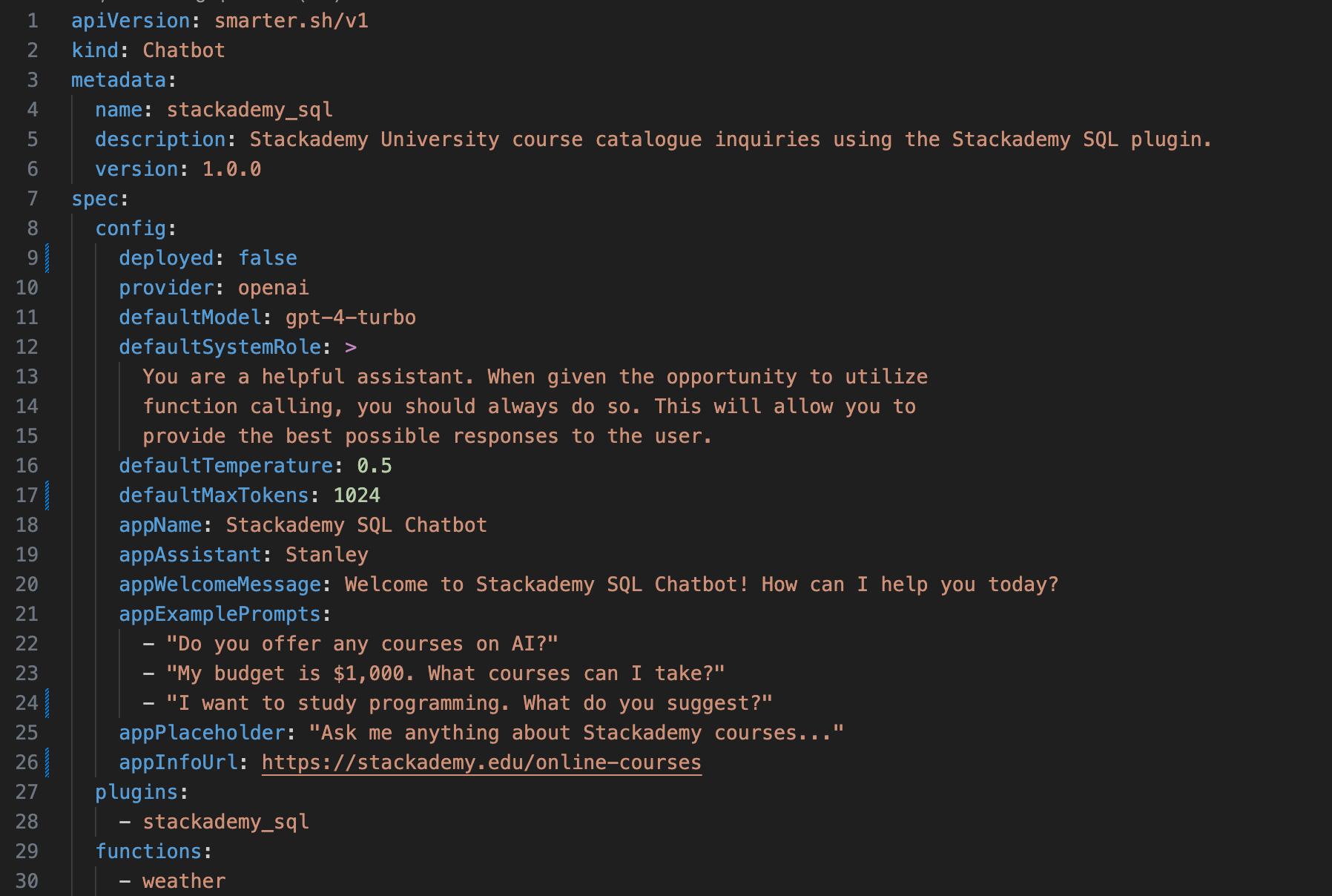
The Smarter Project is an open source, cloud-native platform and developer framework for building sophisticated AI applications without writing a single line of Python. An application that searches the web, queries your databases, calls your APIs, uses the tools of any MCP server, and defends itself against prompt injection and data leaks is described in one short YAML file, and deployed with one command:
console
smarter apply -f my-ai-application.yaml

Why Smarter?
- No code. Just a manifest. A Smarter Manifest (SAM) declares what an application is, rather than programming how it works. Prompt engineers, business analysts, and product managers can build, read, and change production AI applications themselves, and manifests are versioned, reviewed, and deployed from CI/CD like the rest of your infrastructure.
- Every way to reach external data. Each approach is a Resource that you declare in a manifest, with no code: Remote APIs, Remote SQL, MCP servers, the web, skills, and your own documents.
- Governed from the first prompt. Deterministic Guardrails inspect every message on its way to the model and every reply on its way back, and every intervention is recorded.
- Contained by design. No code execution, private networks, hardened outbound requests, role-based access at every layer, and credentials the model never holds. See Security.
- Composed like an orchestra. An LLMClient combines a model from any provider with the plugins, MCP clients, and guardrails it needs, simply by listing them by name, and an Orchestrator coordinates several LLMClients in multi-agent workflows.
- Built for teams. Every Resource has an owner and is shared with everyone in the owner's Account.
- Runs at scale, on your infrastructure. Start with a single Docker container on your laptop, then go to production on Kubernetes with the Smarter Helm chart. No managed-service dependency and no vendor lock-in.
At a Glance
- Get started: Quick Start Guide | Prerequisites | Troubleshooting | Tutorial
- Platform
- A proxy server that gives secure, governed, auditable access to AI providers and resources, without exposing secrets or the underlying vendor accounts.
- Build every AI resource with declarative YAML manifests, with no Python programming, much as you would with Kubernetes.
- Manage resources with the web console, the REST API, and the command-line interface.
- Runs at scale on Kubernetes, with automatic horizontal scaling of application servers and background workers.
- Built-in logging, cost accounting, and security.
- Knowledge and tools
- API, SQL, Websearch, Skill, and Static Plugins.
- MCPClients for the Model Context Protocol ecosystem.
- Vectorstores for semantic search over your own content.
- Trust and safety
- Input and output Guardrails for moderation, self-harm, personal data, data subject requests, leaked secrets, profanity, fabricated citations, prompt injection, jailbreaks, and code injection.
- End-to-end audit, from each Prompt back to the Account that authorized it.
- Models and workflows
- Works with many AI model providers, including OpenAI, Google AI, Meta AI, and DeepSeek, as well as self-hosted models with LLMHost.
- Multi-agent workflows with Orchestrator.
- A prompt engineering workbench for testing applications before you deploy them.
- Developer framework
- For when you do want to write code: built on Django, Django REST Framework, and Pydantic, and the same framework that Smarter itself is built on.
- Automated AWS cloud infrastructure and Kubernetes management.
- A React component that adds a Smarter chat to any web page.
- Python SDK, NPM packages, and a VS Code extension.
Quickstart
This setup uses Docker and takes around 20 minutes for first time installations.
-
Verify project requirements:
- 20Gib disk storage capacity
- 4Gib system memory
- Python 3.14
- Docker,
-
Optionally, add your credentials to .env in the root of this repo. None are needed to run the platform locally:
makecreates.envwith the one required value, an encryption key. Add an LLM provider's API key, such asSMARTER_OPENAI_API_KEY, so that the built-in LLMClients can answer prompts. A feature whose setting is missing logs what to set when it is used. -
Initialize, build and run the application locally.
console
git clone https://github.com/smarter-sh/smarter
make help           # scaffolds a .env file in the root of the repo
                    # Optionally, add your API keys to .env.
make init           # pulls Docker containers, creates a Python virtual environment,
                    # installs all packages, creates and initializes a
                    # local MySql database, preloads example AI resources
make run            # runs all docker containers and starts a
                    # local web server http://localhost:9357/
- Login at http://localhost:9357/login/ with user
admin@example.comand passwordsmarter.
See these onboarding videos:
Key Features
Smarter implements a yaml manifest-based approach to managing AI resources that is inspired by the Kubernetes project.
It provides a unified, declarative way to define, configure, and orchestrate the disparate resources that are required for creating and managing AI resources that integrate to other enterprise resources like REST API's and Sql databases. And it gives prompt engineering teams an intuitive workbench approach to designing, prototyping, testing, deploying and managing powerful AI resources for common corporate use cases including agentic workflows, customer facing chat solutions, and more. It includes a separately managed React-based chat UI that is compatible with a wide variety of front end ecosystems including NPM, Wordpress, Squarespace, Drupal, Office 365, Sharepoint, .Net, Netsuite, salesforce.com, and SAP. There is a Golang command-line interface, and a PyPi package for integrating the API functions into your own Python projects. It is developed to support prompt engineering teams working in large organizations. Accordingly, Smarter provides common enterprise features such as credentials management, team workgroup management, role-based security, accounting cost codes, and logging and audit capabilities.
Smarter provides seamless integration and interoperation between LLMs from DeepSeek, Google AI, Meta AI and OpenAI. It is LLM provider-agnostic, and provides seamless integrations to a continuously evolving list of value added services for security management, prompt content moderation, audit, cost accounting, and workflow management. Smarter is cloud native and runs on Kubernetes, on-site in your data center or in the cloud.
Smarter is cost effective when running at scale. It is extensible and architected on the philosophy of a compact core that does not require customization nor forking. It is horizontally scalable. It is natively multi-tenant, and can be installed alongside your existing systems.
Helm Chart
See ghcr.io/smarter-sh/charts/smarter or Artifact Hub.
Documentation
Read the Docs: docs.smarter.sh
Support
Please report bugs to the GitHub Issues Page for this project.
Contributing
Please see the CONTRIBUTING.